

You pay your monthly pest control invoices like clockwork, yet employee complaints about rodents or insects keep landing on your desk. Product packaging arrives damaged, or telltale droppings appear near the loading docks. For logistics managers, supply chain operators, and facility directors in Baltimore, MD, this is an incredibly frustrating and costly cycle. You are left asking yourself a critical question: why isn’t your warehouse pest control working?
The breakdown rarely lies with the efficacy of the exterminator’s chemical treatments. Instead, the failure occurs because the structural foundation of effective pest prevention is completely missing: rigorous, specialized sanitation. Without deep cleanliness, even the most expensive extermination contract acts as a temporary bandage on a chronic operational wound. To establish a permanently secure environment, you must address the underlying environmental factors that invite pests into your facility.
The Fatal Flaw in Relying Solely on Chemical Extermination
Relying exclusively on sprays, baits, and traps is a fundamentally reactive strategy. These methods target active pest populations but do absolutely nothing to eliminate the root causes of the attraction. Integrated Pest Management (IPM) is the gold standard in modern facility maintenance, dictating that chemical intervention should be the last line of defense, not the first.
Pests require three basic elements to survive, reproduce, and thrive: food, water, and harborage. If your industrial facility continuously provides these resources, pest populations will rebound faster than chemicals can eradicate them. A primary technical reason for bait failure is bait competition. If a rodent has access to spilled organic materials, dropped food items, or accumulated residue behind a rack, it will completely ignore the rodenticide inside a bait station.
Investing heavily in warehouse pest control without addressing industrial cleanliness creates an endless loop of re-infestation. To stop pests permanently, you must eliminate their access to your building and remove the biological attractants that sustain them.
The Hidden Hotspots Undermining Your Facility Maintenance
Warehouses are vast, complex structures with thousands of square feet of hard-to-reach areas. Standard janitorial crews often lack the training and equipment to handle these spaces, allowing specific hotspots to become breeding grounds.
Material Spills and Organic Debris under Racking
Industrial facilities shift thousands of tons of cargo daily. Minor spills of organic materials, grain dust, or liquid goods frequently occur under heavy racking systems where standard daily sweeps cannot reach. Over time, these neglected remnants decay, generating subtle odors that act as a beacon for rodents and insects. Even non-food warehouses face this; cardboard dust and wood shavings from pallets provide excellent nesting material and an alternative food source for silverfish and beetles.
Overhead Structural Accumulation and Trusses
Facility managers often look down when assessing cleanliness, but pests frequently exploit the upper vertical space. High-level trusses, roof beams, and ceiling pipes gather thick layers of dust, cobwebs, and organic matter over time. Birds, bats, and climbing rodents utilize these elevated, undisturbed areas for nesting. From these high vantage points, they easily bypass ground-level traps, contaminating inventory from above with droppings and urine.
Pallet Storage and Long-Term Dead Zones
Warehouses inherently feature dead zones—corners, spaces behind deep racking, and long-term pallet storage areas that rarely see foot traffic or routine disturbance. Stacking damaged wooden pallets creates a perfect maze of harborage points. Debris accumulates rapidly in these gaps, giving pests a secure, dark environment to breed completely unbothered by daily warehouse operations.
How Professional Warehouse Cleaning Services Break the Cycle
Breaking the cycle of persistent pest issues requires moving past superficial cleaning routines and adopting comprehensive industrial cleaning services. Specialized warehouse cleaning services employ industrial-grade equipment and targeted technical approaches designed to eliminate pest attractants at their precise biological source.
Here is how professional sanitation directly supports and amplifies your pest management goals:
-
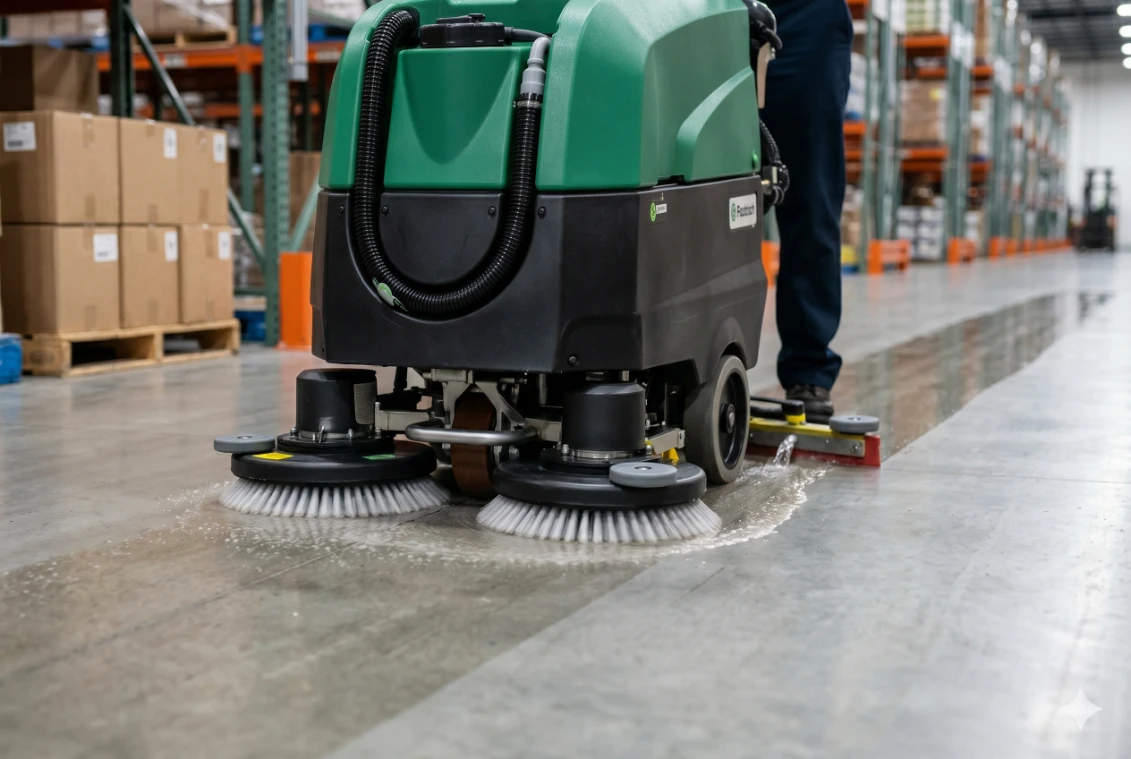
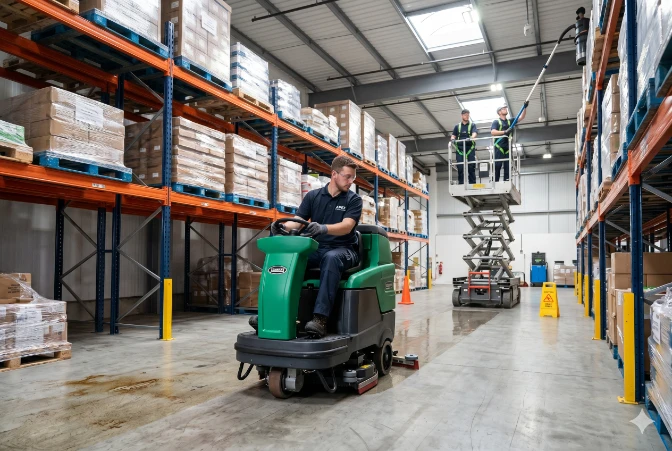
Deep Structural Scrubbing: Utilizing industrial-grade ride-on auto-scrubbers and specialized degreasers to remove deeply embedded residues, oil stains, and organic films from concrete surfaces.
-
High-Reach Remediation: Deploying certified operators on scissor lifts using HEPA vacuum systems to clean high beams, ceilings, and light fixtures, systematically eradicating avian and rodent nesting sites
-
Under-Racking Clearance: Using specialized narrow-clearance machinery and industrial blowers to extract accumulated dust, debris, and lost product packaging from underneath heavy pallet racks.
-
Ramp and Loading Dock Sanitation: Power washing exterior docks, leveling pits, and the immediate perimeter where trash compactors sit, ensuring that pests are not drawn to the facility’s exterior boundaries.
-
Moisture Management and Drainage Deep Cleaning: Cleaning and sanitizing floor drains and trench drains to eliminate standing water and biofilm, which are primary breeding grounds for phorid and drain flies.
The Local Angle: Baltimore’s Unique Facility Maintenance Challenges
Operating a logistics, distribution, or manufacturing hub in Baltimore, MD introduces specific environmental pressures that amplify pest risks. The city’s proximity to major maritime shipping lanes via the Port of Baltimore, combined with humid Mid-Atlantic summers, creates an exceptionally active ecosystem for invasive species and resilient urban pests.
Maritime cargo can introduce non-native insects, while Baltimore’s historic industrial zones feature deeply established rodent networks. When seasonal weather shifts occur—such as the transition from hot, humid summers to freezing winter temperatures—pests are driven forcefully indoors looking for shelter and climate-controlled environments. Standard commercial cleaning routines simply cannot withstand these local challenges. To protect your inventory, maintain regulatory compliance, and pass stringent audits, you need to collaborate with the best cleaning company in Baltimore—one that understands the specific architectural challenges, local pest behaviors, and regional regulatory pressures of Maryland’s industrial corridors.
Implementing a Proactive, Synchronized Maintenance Strategy
A successful facility management program synchronizes your sanitation schedules with your pest control contracts. Do not treat these two operations as separate, isolated silos. When scheduling intensive warehouse cleaning services, coordinate the timing so that your pest control provider inspects and updates bait stations immediately after the deep clean.
A clean floor makes structural vulnerabilities—like tiny foundation cracks, degraded expansion joints, or worn weather stripping under dock doors—instantly visible. This visibility allows your maintenance team to seal entry points before pests can exploit them. True efficiency is realized when industrial cleaning removes the competing food sources, forcing hungry pests directly toward the exterminator’s traps and bait stations.
Partner with Interworld Cleaning for a Pest-Free Facility
Safeguarding your inventory, ensuring the health and safety of your workforce, and maintaining a stellar reputation requires a meticulous approach to facility hygiene. Chemical treatments alone cannot overcome the physical reality of accumulated industrial debris. By prioritizing professional industrial cleaning services alongside your pest management protocols, you establish a resilient, proactive defense system that saves money, protects your bottom line, and minimizes operational disruptions.
Interworld Cleaning provides the heavy-duty, expertly managed cleaning solutions that modern distribution centers, fulfillment spaces, and manufacturing plants require. As an elite provider of comprehensive commercial and industrial cleaning, our highly trained teams are equipped to handle the toughest warehouse environments, helping you achieve a truly pristine, pest-repellent facility.