

Seasonal weather shifts across Baltimore, MD create ongoing challenges for school facility managers. Implementing strategic school air quality cleaning is critical to stop mold growth in aging buildings before it impacts student health.
Effective school air quality cleaning is absolutely critical. It goes far beyond basic daily trash removal. Instead, it defends your building against aggressive environmental decay. Therefore, proactive maintenance protects both operational budgets and developing lungs. Poor air quality directly impacts student test scores. Furthermore, it drives up expensive teacher absentee rates. Clearly, you must address these invisible threats head-on.
The Seasonal Crisis in Baltimore Educational Facilities
Maryland weather is notoriously volatile and unpredictable. Heating and cooling seasonal transitions disrupt indoor climates drastically. Naturally, aging Baltimore schools bear the brunt of this. Old building envelopes leak moisture continuously. As a result, indoor relative humidity easily exceeds 60%. This specific threshold triggers a dangerous biological chain reaction. When combined with stagnant air, dormant mold spores germinate. They target aging drywall, acoustic ceiling tiles, and carpet fibers.
During September and October, the HVAC systems run constantly. However, they fail to dehumidify the fresh air intake properly. This creates an immediate condensation problem on interior masonry. Meanwhile, spring brings heavy rains and rising groundwater levels. These seasonal extremes test the limits of older Baltimore architecture.
Soon, facility managers face angry parent complaints about asthma. Additionally, teacher and student absenteeism rates climb rapidly. Nobody wants to fund emergency structural remediation projects. Tearing out contaminated walls ruins operating budgets instantly. Fortunately, specialized educational facility janitorial services offer a better alternative. Proper daily maintenance stops biological growth early on. Therefore, strategic cleaning acts as your primary line of defense. It prevents costly tear-outs and protects occupant health. Indeed, controlling the environment allows you to control the outcomes.
Fine Particulates and School Air Quality Cleaning Dynamics
Poor air quality starts at the microscopic level. Fine particulate matter, or PM2.5, builds up daily. These tiny particles settle on classroom surfaces constantly. Aging ductwork pushes this dust around the building continuously. Dust mites thrive in these poorly ventilated educational spaces. Their microscopic feces mix with outdoor soil pollutants continuously. Together, they create a highly toxic particulate cocktail. Furthermore, children breathe at a much faster rate than adults. Therefore, they absorb these indoor pollutants at an alarming pace. Protecting their respiratory health is an ethical and legal obligation.
Unfortunately, traditional cleaning methods make this situation much worse. Standard sweeping launches dangerous micro-allergens into the ambient air. Likewise, non-HEPA vacuuming simply recirculates fine dust everywhere. Students then inhale these particles right in their breathing zone. This physical agitation feeds potential microscopic mold colonies. Consequently, everyday dirt becomes food for fungal spores.
To fix this, HEPA filtration school cleaning is strictly mandatory. True HEPA filters capture microscopic0.3 micron particles. Specifically, they operate at an impressive 99.97 efficiency rate. Therefore, they trap biological contaminants instead of moving them. This physical extraction is a core pillar, it removes the physical particulate load completely. Without this extraction, other cleaning efforts simply fail.
Chemistry Rules for School Air Quality Cleaning
When custodians spot mold, they often grab industrial bleach. However, this is a dangerous and highly ineffective reaction. Bleach is completely inappropriate for porous surfaces in schools. It simply does not work on drywall or ceiling tiles.
First, industrial bleach off-gasses harmful volatile organic compounds (VOCs). These toxic VOCs trigger asthma and irritate developing lungs. Second, bleach fails to kill subsurface mold root structures. These root systems, known scientifically as hyphae, survive deep inside materials. The bleach merely turns the visible surface structure white. Consequently, the mold quickly returns with a vengeance.
Instead, schools must utilize modern, scientifically formulated cleaning chemistry. Professional teams deploy GS-37 certified green antimicrobials. These advanced surface-active agents penetrate porous substrates safely. They destroy the biological threat without toxic chemical off-gassing. Many off-the-shelf industrial cleaners contain harsh quaternary ammonium compounds. These chemicals bind to surfaces and leave a sticky residue. Subsequently, this residue actually attracts more dirt and dust. It creates a vicious cycle of chemical buildup and contamination. Green chemistry avoids this dangerous and counterproductive residue trap entirely.
Furthermore, using these specific products ensures total Maryland green cleaning compliance. This protects building occupants and satisfies strict state regulations. Obviously, it is the responsible way to manage biological threats.
Strategic School Air Quality Cleaning Routine
Consistent operational protocols prevent catastrophic indoor air failures. Professional commercial cleaning teams execute targeted moisture control nightly. Below is our proven, multi-point operational strategy for schools. Ultimately, this strict routine ensures proper school indoor air quality cleaning.
- Micro-Particulate Extraction: First, technicians deploy certified HEPA vacuums. They meticulously target all hard floors and broadloom carpets. Consequently, we capture
PM2.5allergens permanently every single night. This effectively stops recirculation into the aging HVAC system. - Targeted Moisture Mapping: Next, highly trained staff identify micro-leaks. They monitor condensation pooling directly on window sills. Additionally, they check for damp acoustic ceiling tiles nightly. This allows property managers to address dangerous humidity spikes immediately.
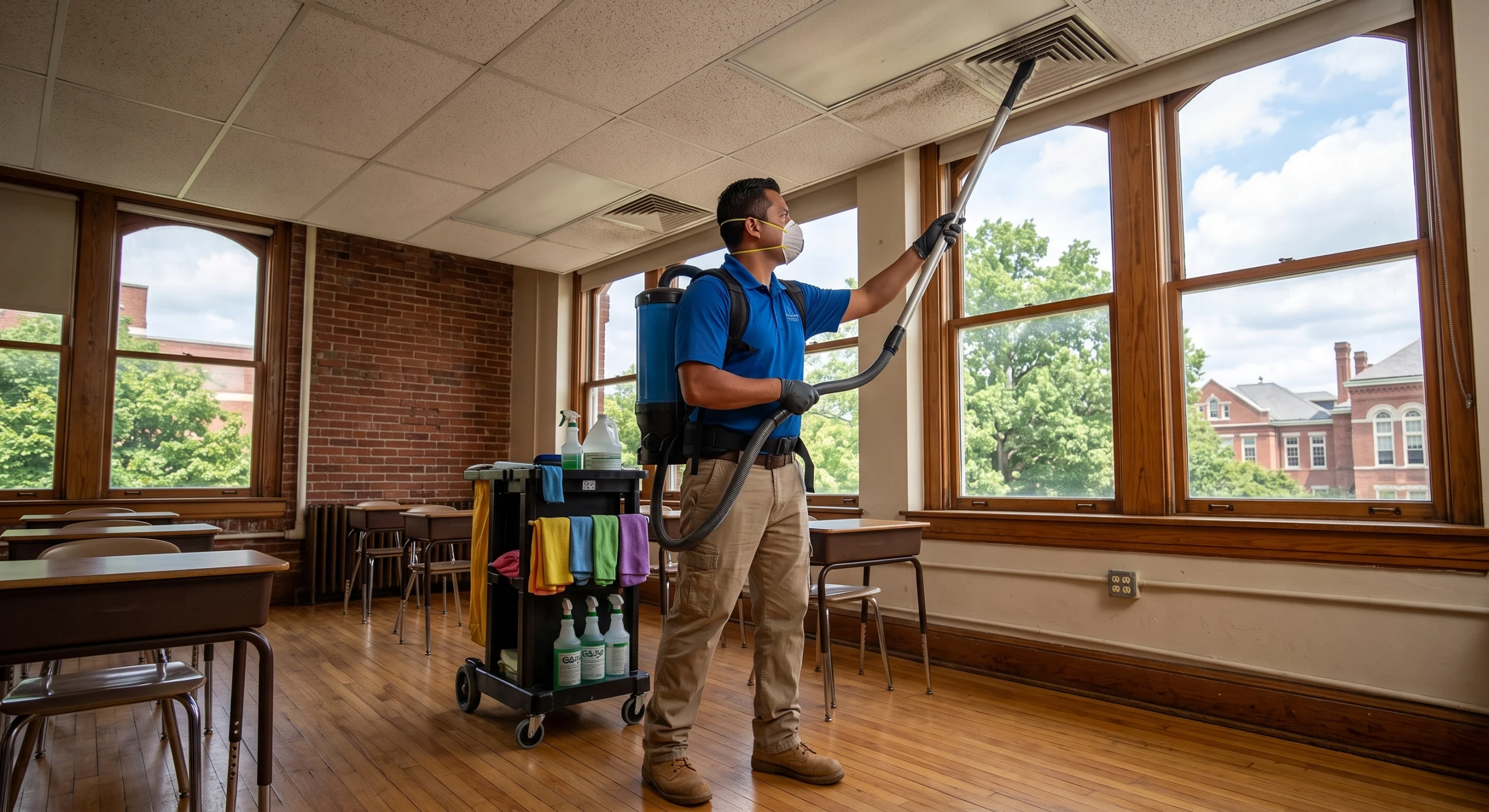
- HVAC Register Detailing: Then, we damp-wipe classroom supply vents weekly. Crews also carefully clean return grilles and adjacent ceilings. We utilize specialized electrostatic microfiber technology for this task. Ultimately, this removes heavy dust that chokes critical airflow.
- Strategic Antimicrobial Application: Afterward, we treat targeted high-touch surfaces. We apply GS-37 certified green disinfectants very precisely. Technicians strictly ensure the exact required chemical dwell times. Therefore, we achieve total biological neutralization without harmful VOCs.
- Hard Surface Bio-Load Reduction: Finally, teams use dual-chamber flat-mop systems. These advanced tools physically remove organic soils from long hallways. Consequently, we starve potential mold colonies of vital nutrients.
This rigorous routine significantly reduces costly structural remediation risks. It provides the reliable school mold mitigation Baltimore facilities urgently need.
Defending Your Assets with Commercial Cleaning
Reactive facility maintenance destroys school operating budgets extremely quickly. Waiting for visible mold guarantees a highly expensive crisis. Emergency remediation projects disrupt learning and cost thousands. Conversely, daily strategic hygiene is an incredibly cost-effective approach. Replacing a single classroom's ruined acoustic ceiling tiles is expensive. However, replacing water-logged commercial carpet is even more financially devastating.
A comprehensive janitorial strategy acts as an insurance policy. It detects early warning signs before major water damage occurs. Proper commercial school cleaning Baltimore MD protects your capital investments. It significantly extends the lifespan of expensive flooring and paint. More importantly, it aggressively defends the health of your community. You cannot afford to ignore proactive environmental building maintenance. Every dollar spent on prevention saves ten on remediation. Therefore, upgrading your janitorial standards is a wise financial decision.
Solving Internal Staffing Gaps in Educational Facilities
Private school headmasters often struggle with in-house janitorial teams. High employee turnover disrupts daily cleaning consistency severely. Additionally, internal staff usually lack advanced environmental science training. They simply do not understand complex PM2.5 or hyphae removal.
Outsourcing to a specialized regional contractor solves this problem instantly. We immediately provide the technical expertise and the high-end equipment. Consequently, your facility receives guaranteed high-spec hygiene standards nightly. You shift the massive burden of training and chemical compliance. Instead, you rely completely on dedicated environmental hygiene experts. This frees up your administration to focus entirely on education.
Secure Your Educational Facility's Future
Maintaining exceptionally healthy indoor air is an absolute operational necessity. It directly impacts student academic performance and long-term staff retention. Do not let outdated cleaning methods ruin your historic building. Instead, partner with the trusted regional experts at Interworld Cleaning. We deliver the exact school indoor air quality cleaning you require. Our professional team stops hidden biological threats before they start. We understand the strict demands of modern educational real estate. Take decisive action to protect your educational facility today. Request a Commercial School Air Quality & Surface Hygiene Assessment from Interworld Cleaning.