

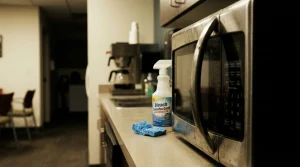
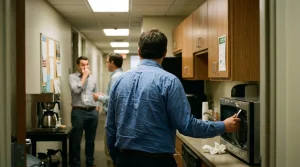
You are staring at the shared breakroom microwave, wondering whose job it was to wipe the handle today. Meanwhile, down the hall, employees are complaining about the lingering, harsh chemical smell of bleach from a well-meaning colleague’s panicked desk wipe-down. Managing flu-season office sanitizing shouldn’t mean arbitrating disputes over kitchen sponges, tracking down missing surface sprays, or apologizing for inconsistent wiping routines.
In fact, influenza viruses do not respect internal office politics. According to CDC guidelines on viral persistence, they survive on hard, non-porous surfaces for up to 48 hours. For example, a sick employee touching a conference room door handle on Friday afternoon leaves a live pathogen waiting for the Monday morning shift. Therefore, when left to chance without a dedicated commercial cleaning company, uncoordinated wiping routines turn into a genuine operational liability, threatening both employee health and overall productivity.
Cleaning vs. Sanitizing vs. Disinfecting: The Technical Divide
Ultimately, facility health relies on understanding the distinct differences between cleaning, sanitizing, and disinfecting. However, office managers frequently see these terms used interchangeably, which leads directly to massive gaps in infection control.
First, cleaning removes visible soil, dust, and debris. Specifically, soap, water, and basic friction accomplish this. As a result, cleaning prepares a surface but does not reliably neutralize pathogens.
Second, sanitizing reduces the total number of bacteria on a surface to a level considered safe by public health standards. Although it lowers the risk of infection, it does not eliminate all threats.
Finally, disinfecting utilizes EPA-registered chemicals to actively destroy specific viruses and bacteria at a microscopic level.
The science of application dictates exactly how these processes interact. However, you cannot disinfect a dirty surface because dirt, oils from human hands, and organic grime create a physical shield around pathogens. Consequently, you must physically pre-clean surface dirt before applying any chemical killer.
Next comes the most common point of failure in DIY office sanitation: dwell time. Also known as contact time, this is the exact number of minutes a chemical must remain visibly wet on a surface to kill specific viruses. For instance, many standard commercial chemicals require surfaces to stay wet for four to ten minutes to effectively neutralize the influenza virus. Therefore, spraying a communal desk and immediately wiping it dry does absolutely nothing to stop the flu; it simply moves live viruses to a new location.
The High-Touch Surface Checklist
Aligning your daily routines with CDC guidance ensures your high-touch surface cleaning targets the areas most responsible for cross-contamination. Use this matrix to establish clear boundaries regarding who cleans what, and how often it happens during peak viral months.
| Surface / Touchpoint | Suggested Frequency (Flu Season) | Typical Responsibility |
|---|---|---|
|
Door Handles & Push Plates |
Multiple times daily | Janitorial Staff / Porters |
|
Stair Handrails |
Daily | Janitorial Staff |
|
Elevator Buttons |
Multiple times daily | Janitorial Staff / Porters |
|
Conference Room Touchpads/Remotes |
After every meeting |
Meeting Organizer / Employees |
|
Restroom Fixtures (Faucets, Dispensers) |
Multiple times daily |
Janitorial Staff |
|
Personal & Shared Desks |
Daily / Between shifts | Individual Employees (Light) / Janitorial (Deep) |
| Kitchen Counters & Appliance Handles | After every meal period |
Janitorial Staff |
Mid-Article Action: Are your high-touch surfaces silently spreading illness? Stop guessing and start protecting your workforce. Contact Interworld Cleaning today for a Free Facility High-Touch Assessment to identify your exact vulnerabilities.
In-House Cleaning vs. Professional Flu-Season Office Sanitizing
Let’s establish an honest operational reality. On one hand, light, daily desk wipe-downs are perfectly manageable in-house. Expecting your team to manage their own keyboards, computer mice, and personal coffee mugs is a reasonable baseline. On the other hand, expecting your marketing team or HR department to execute rigorous commercial office disinfection is a failure of resource management.
To start, identify your internal operational gap objectively. For instance, if your facility operates on multi-shift coverage, your daily foot traffic exceeds fifty people, or you lack the internal coordination to guarantee strict chemical dwell times on high-risk surfaces like restroom fixtures, you have crossed the threshold. Indeed, leaving complex, after-hours deep cleaning services in Baltimore to tired employees rushing out the door guarantees failure.
That is where our professionals step in to provide consistency, chemical accountability, and dedicated labor. Clear boundaries build trust. Let your internal team handle the work you hired them for; let professional janitorial services handle the pathogens.
Flu-Season Office Sanitizing Plans & Pricing Drivers
Transparent facility management janitorial solutions rely on specific, measurable metrics, not guesswork or flat-rate estimates. In fact, a generic cleaning schedule wastes your operating budget.
True scope customization dictates cleaning frequency based on your exact environment. Specifically, we measure daily occupant headcount, total usable square footage, foot traffic density, and shift schedules. For example, a high-volume call center operating twenty-four hours a day requires vastly different sanitation protocols—and frequencies—than a traditional nine-to-five boutique architectural firm.
You deserve total transparency regarding what drives commercial quote costs up or down. We do not invent arbitrary rates. Costs scale with the exact labor hours and chemical volume required to keep your environment healthy. Specific pricing factors include:
- Specialized Equipment: Deployment of electrostatic sprayers for rapid, 360-degree surface coating.
- Frequency of Deep Sanitizing Runs: How often crews must execute high-level viral neutralization protocols.
- High-Traffic Zones: The density and square footage of lobbies, breakrooms, and multi-stall restrooms that demand constant attention.
Why Choose Interworld Cleaning
Securing high-quality office cleaning services in Baltimore and executing effective flu-season office sanitizing requires looking past empty marketing claims and demanding verifiable proof of competency. To solve this, Interworld Cleaning brings industrial-grade health standards directly to your commercial spaces. In addition, we specialize in targeted disinfection cleaning services in Baltimore, eliminating employee complaints about harsh smells by utilizing low-VOC green disinfectant options. Furthermore, our crews deploy advanced electrostatic sprayer technology, ensuring disinfectant wraps around complex surfaces providing coverage that traditional rags simply cannot match.
In order to protect your investment, we maintain accountability through documented quality-check inspections long after the initial contract is signed. Likewise, we operate with full liability insurance coverage to protect your physical assets, and we mandate complimentary site walkthroughs before ever submitting a proposal. In short, mastering flu-season office sanitizing means trusting a regional leader with the infrastructure to deliver consistent results.
Proactive Objection Handling & Next Steps
Delegating your facility’s health to an outside contractor naturally raises logistical questions. We proactively resolve the common concerns that keep office managers up at night:
- Minimizing Business Disruption: First, we design flexible after-hours and night shift service schedules to ensure absolutely zero disruption to your daily operations or employee productivity.
- Security and Access Protocols: Second, your building’s security is paramount, so we enforce strict keycard handling procedures and exclusively deploy thoroughly background-checked cleaning crews.
- Equipment and Supply Procurement: Third, you never have to track down mop buckets or check chemical inventory again because we provide all necessary equipment, commercial-grade application tools, and EPA-registered disinfectants.
- Contract Flexibility: Finally, we provide adaptable contract terms and absolute quote transparency, meaning you pay for the exact scope of services you need, structured to match your seasonal foot traffic.
Do not let another wave of seasonal illness dictate your facility’s productivity. Developing a successful flu-season office sanitizing strategy requires decisive, professional action.
Request an office cleaning assessment today. Specifically, your exact next steps include a comprehensive onsite visit, a detailed high-touch surface audit, a customized scope and frequency proposal, and a transparent, no-obligation quote.
To take control of your facility’s health, visit our office cleaning services page to schedule your assessment now.