Look straight up. If you are sitting in your living room, retail shop, or office right now, you likely haven’t thought about how to clean ceilings in months—maybe years.
Because ceilings represent the largest continuous surface area in any room, neglecting them creates serious indoor air risks. In fact, every time your HVAC system kicks on, drafts sweep across dust-laden overhead surfaces, dislodging fine particulates back into your breathing zone. Therefore, learning how to clean ceilings safely is essential for property owners who want to maintain pristine, healthy indoor spaces.
Why Ceilings Get Dirty: Understanding How to Clean Ceilings Effectively
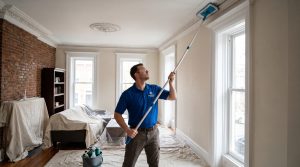
Dust does not simply settle downward. Overhead buildup is driven by thermal dynamics and surface physics.
Warm air naturally rises through thermal convection currents. As indoor air travels upward, it carries microscopic airborne contaminants: aerosolized cooking oils, candle soot, fireplace carbon, skin flakes, and volatile organic compounds (VOCs). When these warm air currents brush against overhead substrates, electrostatic charges naturally present on drywall, plaster, and acoustic ceiling tiles attract and bind these floating particles.
Over time, this accumulation forms an invisible, sticky matrix. The type of surface dictates how that grime bonds:
-
-
Standard Painted Drywall: Typically coated in ultra-flat latex paint, which has an open-pored profile designed to hide framing imperfections. Consequently, that rough texture readily traps airborne oils.
-
Historic Plaster: Common in Baltimore’s historic 19th-century architecture, plaster expands and contracts with ambient humidity. Because of this, soot particles become trapped deep within microscopic fissures.
-
Commercial Acoustic Tiles: These surfaces are porous, fibrous, and fragile. Specifically, mineral-fiber drop tiles absorb airborne grease and moisture like a sponge, making aggressive wet cleaning impossible without structural collapse.
-
Understanding these materials prevents accidental property damage before you ever lift a mop.
Cleaning Chemistry: How to Clean Ceilings Without Damaging Paint
Before grabbing random household cleaning agents, consider the chemical sensitivity of overhead paint. Flat ceiling latex is notoriously thin and water-sensitive. Saturating it with hot water dissolves water-soluble binders, causing immediate paint bubbling, blistering, and permanent gray water rings.
Two chemical rules protect your overhead surfaces:
-
Ditch the Chlorine Bleach: Bleach is an oxidizer, not a surfactant. On porous substrates like flat paint, plaster, or acoustic fiber, bleach simply bleaches the color out of organic grime while driving moisture deeper into the backing material. It does not lift soil and can corrode underlying metal lath or framing.
-
Rely on Neutral-pH Surfactants: To cut through grime safely, use a pH-neutral or mild degreasing surfactant (such as standard unscented dish detergent diluted in warm water, or a specialized neutral surface cleaner). Surfactants work by reducing the surface tension of water, encapsulating oily particulates so they lift cleanly away without degrading paint resins.
Step-by-Step Guide: How to Clean Ceilings Safely
Master how to clean ceilings by following a strict dry-to-damp progression. Never apply liquids to an un-dusted surface; doing so creates an oily slurry that smears deep into porous paint textures.
- Protect the Workspace
First, move light furniture out of the work zone and drape clean plastic drop cloths over floors, heavy tables, and electronics. Additionally, wear wrap-around safety glasses and a dust mask, since overhead work dislodges particulate matter directly into your eyes and respiratory tract. - Electrostatic Dry Dusting
Next, begin by eliminating loose, dry debris. Attach a split-fiber electrostatic microfiber duster or a soft brush vacuum attachment to a sturdy telescoping pole. Work in overlapping horizontal passes, starting from the perimeter corners and moving toward the center of the room. However, do not apply heavy upward pressure—let the static fibers attract the loose dust naturally.
3. Controlled Low-Moisture Damp Wiping
Mix one teaspoon of mild, neutral surfactant into one gallon of warm water in a dedicated bucket. Prepare a second bucket with clean, lukewarm rinse water.
First, dip a flat microfiber mop pad into the cleaning solution and wring it out until it is barely damp to the touch. Next, attach the pad to your pole and wipe a 4×4-foot grid using light, continuous parallel strokes. Afterward, immediately switch to a pad dampened with clean rinse water to lift surfactant residue, followed by a dry microfiber cloth to extract moisture.
4. Controlled Airflow Drying
Finally, turn on room ceiling fans or set up floor air movers to circulate air immediately after wiping. Consequently, rapid drying prevents flat latex from absorbing moisture and peeling.
How to Clean Ceilings with Stubborn Stains and Grime
Different rooms generate distinctly different contamination footprints. Here is how to handle the three most common problem areas:
Kitchen Grease Film
Cooking fats vaporize, travel upward, and cool against the ceiling, forming an amber, tacky film that gathers stray dust.
-
The Fix: Use a targeted solution of warm water mixed with an alkaline, residue-free cleaner or grease-cutting dish detergent. Work in small sections, allowing the surfactant 60 seconds of dwell time to emulsify the lipids before lifting with a damp microfiber pad. Never scrub aggressively, or you will create shiny burnish marks across flat paint.
Bathroom Moisture & Mildew Shadowing
High humidity coupled with inadequate ventilation creates prime real estate for surface mildew along ceiling seams.
- The Fix: Instead of chlorine bleach, apply a 3% hydrogen peroxide solution via a lightly misted microfiber pad. Hydrogen peroxide penetrates the fungal cell wall safely, thereby lifting dark discoloration without harsh fumes. In addition, ensure the room’s exhaust fan is vacuumed clean to prevent recontamination.
Black HVAC Diffuser Streaks (Ghosting)
Dark, feathery stains radiating outward from supply vents and ceiling diffusers are commonly mistaken for black mold. This phenomenon, known as “ghosting” or vent smudging, is caused by particulate deposition. Air moving rapidly across the diffuser creates a localized pressure drop, pulling room air and suspended soot against the drywall.
-
The Fix: First, swap your HVAC filters. To clean the paint, use a dry rubber soot sponge (chemical sponge). Press the dry vulcanized rubber sponge firmly against the streaks and wipe in straight, unidirectional strokes. The porous rubber absorbs carbon and soot particulates without liquid, preventing smears.
When to Call the Pros: How to Clean Ceilings in Complex Spaces
Knowing how to clean your ceiling yourself works well for routine maintenance on standard-height, durable surfaces. However, structural and safety limitations quickly emerge.
High-Ceiling Rowhomes and Lofts
In historic Baltimore neighborhoods like Mount Vernon, Canton, and Fells Point, 11- to 14-foot original lath-and-plaster ceilings are common. Balancing on stepladders with extension poles presents severe fall hazards. Plaster also requires delicate, specialized handling; excessive localized pressure can crack historical crown molding or separate weakened plaster keys from joists.
Commercial Workspaces & Acoustic Drop Tiles
For facilities in downtown Baltimore commercial corridors, suspended acoustic drop-ceiling tiles present an entirely different problem. Damp-wiping mineral fiber tiles causes warping, discoloration, and structural sagging. Commercial kitchens, healthcare clinics, and retail storefronts demand specialized ceiling restoration equipment, high-volume particulate vacuums, and commercial enzyme fogging techniques to lift embedded oils without soaking materials.
When safety risks, fragile historical materials, or large square footages make manual cleaning impractical, turn to certified specialists. Interworld Cleaning delivers comprehensive residential ceiling cleaning for historic homes and apartments, alongside full-scale commercial ceiling cleaning Baltimore property managers rely on to maintain lease standards.
Our crews utilize commercial-grade, HEPA-filtered vacuum containment and specialized lift equipment to safely remove ceiling stains and soot without damaging fragile coatings. Paired with our complete suite of professional deep cleaning services, we restore overhead aesthetics while measurably upgrading your indoor air quality Baltimore MD facilities require for healthy living and working.
Protect your property’s value, extend the lifespan of your paint, and ensure your building breathes clean air from top to bottom. Visit Interworld Cleaning today to schedule an on-site consultation or request a transparent, free quote for your home or commercial facility.