If you’ve just finished a renovation, calculating the exact drywall dust settling time is the only way to know when your space is truly safe to live or work in again. The tools are packed away, but a fine white film covers every surface. You wipe down the counters, leave the room, and within an hour, suspended particles settle right back onto your finishes.
Under still air conditions with the HVAC off, standard drywall dust settling time is 24 to 48 hours. Active air currents change everything. If your HVAC runs or fans spin, fine particles stay airborne for weeks.
Understanding why this happens—and how to permanently remove the contamination—is critical for protecting your lungs, your HVAC system, and your sanity.
Drywall Dust Settling Time and Particle Physics
To understand why drywall dust is so difficult to capture, you have to look at what it actually is.
Drywall joint compound isn’t just “dirt.” It is a composite material made primarily of gypsum (calcium sulfate dihydrate), calcite, mica, and, most concerningly, crystalline silica.
When contractors sand joint compound, they create particulate matter that falls into the PM2.5 to PM10 size range. To put that in perspective, PM2.5 particles are 30 times smaller than a single strand of human hair.
Because these particles are microscopic, they have an incredibly low terminal settling velocity. This means that gravity has very little effect on them. Even the minor air displacement caused by walking across a room is enough to kick settled drywall dust back into the breathing zone.
The Dangers of Inhalation and Mechanical Damage
Ignoring drywall dust or attempting to clean it incorrectly poses two major risks:
- The Respiratory Health Risk
Inhaling gypsum and crystalline silica irritates the respiratory tract. For example, short-term exposure causes coughing, throat irritation, and aggravated asthma. Long-term or heavy exposure to respirable crystalline silica is a known cause of silicosis—a severe and irreversible lung disease.
A single renovation will not cause silicosis. Still, breathing concentrated gypsum ruins your indoor air quality. - The HVAC and Equipment Risk
Drywall dust is an abrasive desiccant. It aggressively draws in moisture and binds to surfaces.
The Vacuum Trap:
Never use a household vacuum on drywall dust. Fine particles pass straight through standard paper filters. They blast out the exhaust port directly back into the room. Worse, the gypsum acts like sandpaper on the vacuum’s internal motor bearings, frequently causing the motor to burn out.
The HVAC Nightmare:
Running your AC during cleanup sucks dust straight into the ductwork. Drywall dust in HVAC systems coats evaporator coils and restricts airflow. Over time, it burns out the blower motor.
How to Clean Surfaces and Cut Drywall Dust Settling Time
If you are dealing with a small, isolated drywall repair (like patching a few holes), you can handle the cleanup yourself. You just need patience and the right methodology.
Never use a dry broom. Sweeping launches particles back into the breathing zone. This resets your drywall dust settling time back to zero.
Follow this protocol instead:
- Turn Off the Air Circulation: Shut down your HVAC system at the thermostat. Turn off all ceiling fans. Close the windows to prevent cross-breezes. You must create static air.
- Wait: Give the room a minimum of 24 hours of total stillness to allow the bulk of the particulate to hit the floor.
- Use a Shop-Vac with a HEPA Filter (Not a House Vacuum): You must equip a wet/dry vac with a specialized fine-dust bag and a certified HEPA cartridge filter. Slowly vacuum the bulk dust from the floors and ledges.
Safe Surface Wiping and Air Recovery Protocol
- The Wet-Wipe Method: Fill a bucket with warm water and a few drops of dish soap. Dip a microfiber cloth into the water and wring it out until it is barely damp. Wipe down walls (top to bottom), baseboards, and window sills. Fold the cloth frequently to expose a clean side.
- Rinse and Repeat: You will likely need to repeat the damp wiping process two to three times over a few days as the absolute finest microscopic particles finally drift to the ground.
- Replace Your HVAC Filter: Once the space is clean, turn the HVAC back on and immediately swap out your furnace filter for a high MERV-rated pleated filter to catch any stragglers.
When DIY Works vs. When to Hire Post-Construction Cleaners
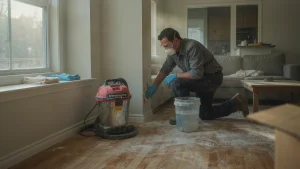
The DIY wet-wipe method works for patching a hole or finishing a single closet. It does not work for whole-home remodels, commercial tenant improvements, or major additions.
If you try to tackle a full-scale renovation cleanup by yourself, you will spend weeks chasing the dust, burning out domestic vacuums, and constantly re-cleaning surfaces as the dust recirculates.
In contrast, professional post-construction cleaners don’t wait for gravity. They manipulate the air.
At Interworld Cleaning, our crews arrive equipped with industrial, multi-stage HEPA vacuums that capture 99.97% of particles down to 0.3 microns. Furthermore, for large-scale dust contamination, we utilize a HEPA air scrubber for drywall dust.
These machines actively pull the contaminated indoor air through massive filtration banks, trapping the suspended microscopic silica and gypsum while we clean. We do not wait on standard drywall dust settling time. Instead, our scrubbers pull particulate out of the air continuously.
Whether you are a facility manager overseeing a retail build-out or a homeowner exhausted by a messy remodel, a commercial post construction cleanup crew dramatically accelerates your timeline.
Clear the Air with Interworld Cleaning Ultimately, lingering drywall dust isn’t just an aesthetic nuisance that makes your new countertops look dirty; it is a persistent environmental health hazard and a direct threat to your expensive HVAC infrastructure. Waiting days for gravity to do the work, only to accidentally kick the dust back up by walking through the room, is a frustrating, losing battle.
If you are dealing with the aftermath of a major renovation in Baltimore, MD, or the surrounding Maryland, DC, and Virginia areas, you don’t have to live with the dust.
Interworld Cleaning provides meticulous, technical post-construction cleaning in Baltimore. We specialize in high-efficiency particulate removal, surface decontamination, and getting your residential or commercial space move-in ready immediately.
Don’t let renovation dust ruin the finish of your new space or compromise your indoor air quality. Contact Interworld Cleaning today to schedule a walkthrough or request a fast, free estimate. Let our experts clear the air so you can finally enjoy the results of your construction project.