

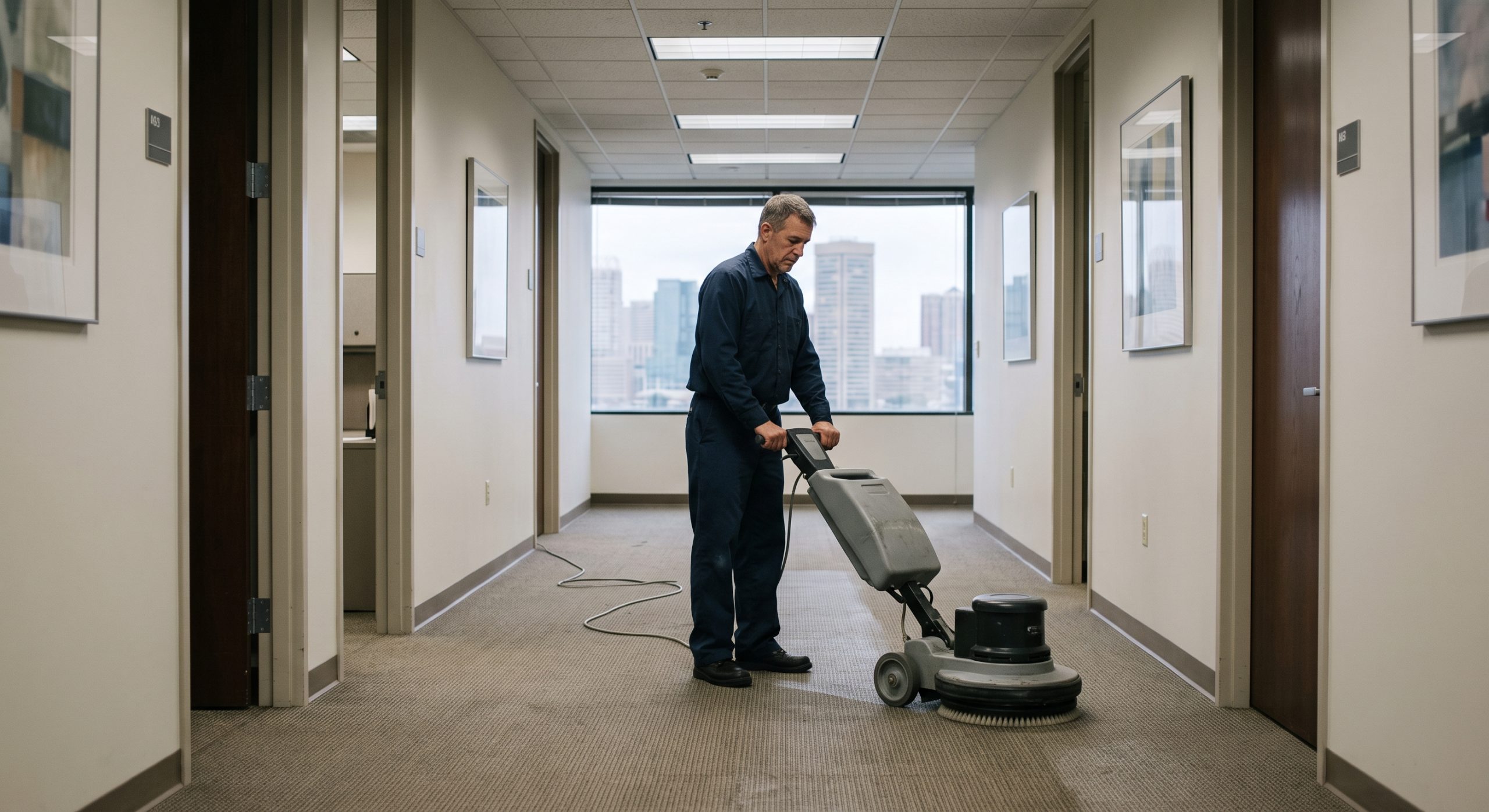
Facility managers know the frustration all too well. A heavy traffic lane looks immaculate on Friday evening after a deep extraction. However, ugly dark spots often creep back up the fibers by Monday morning. These phantom stains aren’t new spills. They are the direct result of outdated maintenance methods failing to account for textile physics. Modern commercial facilities cannot afford the liability, lost productivity, or visual embarrassment of chronically damp floors. Shifting to low-moisture office carpet cleaning resolves these structural maintenance flaws by leveraging advanced polymer chemistry.
Preventing Stain Wick-Back with Low-Moisture Office Carpet Cleaning
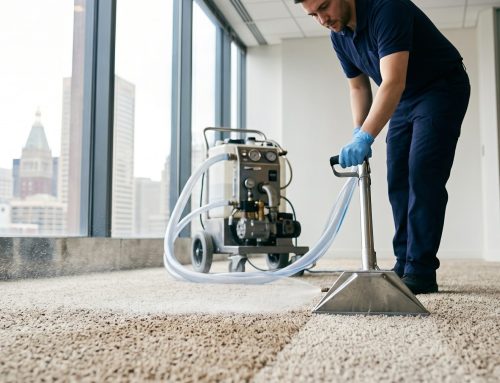
To stop recurring spots, facility directors first have to understand why they happen. The root cause usually lies in the mechanics of traditional hot water extraction, commonly referred to as steam cleaning. While powerful for restorative work, this method relies on extreme water volume. Over-wetting saturates the carpet backing and foam pad. Consequently, capillary action pulls trapped subsurface soil straight up to the surface.
During a slow, 12-to-24-hour drying window, the moisture evaporates upward toward the air. As this water travels up the carpet shaft to the surface, it acts as an elevator. It carries dissolved subsurface soils and oily residues right along with it. Once the water finally evaporates at the very tip of the carpet fiber, the heavy soil remains behind. This phenomenon is precisely why spots magically reappear days after a heavy cleaning. As a result, reducing fluid volume eliminates upward moisture migration. This effectively prevents stain wick-back at its structural source.
Carpet Encapsulation vs Steam Extraction: A Chemistry Perspective
When comparing carpet encapsulation vs steam extraction, drying times are only part of the story. Facility directors must therefore examine polymer chemistry. Traditional carpet shampoos and extraction detergents rely heavily on liquid surfactants. Unrinsed chemical surfactants leave behind a sticky, hygroscopic residue. In fact, sticky chemical residues act like dirt magnets. They attract shoe soil and trigger rapid re-soiling in high-traffic lobbies.
Encapsulation flips this chemical dynamic entirely. Low-moisture office carpet cleaning utilizes advanced crystallizing polymers engineered to bind with debris. Once applied, these specialized cleaning agents target sticky soils. In addition, they detach oily particles from the synthetic fibers. As the low-moisture solution dries—usually within just 30 to 60 minutes—the hydrophobic polymers surround and isolate the soil particles. They dry into microscopic, non-sticky crystals that no longer adhere to the carpet fiber.
Because this encapsulation chemistry leaves zero sticky detergent residue, the carpet stays visually clean for significantly longer periods. You are no longer relying on hundreds of gallons of boiling water to manually flush out dirt. Instead, you are utilizing smart, targeted chemistry to detach and crystallize the soil so it can be easily removed through daily facility upkeep.
The 5-Step Low-Moisture Office Carpet Cleaning Process
Implementing this advanced chemistry requires specialized mechanical agitation to ensure the polymers coat every side of the carpet fiber. Here is the highly structured process professional operations teams utilize to maximize cleanliness:
-
Thorough Pre-Vacuuming: The foundation of any commercial textile maintenance. Using commercial-grade HEPA vacuums, technicians extract loose, dry particulate soil before introducing any moisture. This step prevents the creation of heavy mud at the base of the carpet fibers.
-
Polymer Application: First, apply a precise dilution of encapsulation chemistry. Next, target heavy traffic lanes, cubicle entries, and high-use zones evenly.
-
Counter-Rotating Brush (CRB) Agitation: Specialized cylindrical brush machines lift the carpet pile and mechanically work the polymer deep into the synthetic fibers. The CRB lifts embedded hair, paper clips, and sticky soils while ensuring complete, 360-degree chemical coverage.
-
Rapid Crystallization: The treated area dries in less than an hour. During this short window, the polymers detach the oily soils and encapsulate them into brittle, non-sticky microscopic crystals.
-
Routine HEPA Vacuum Recovery: Once dry, the encapsulated soil crystals are simply vacuumed away during regular nightly janitorial service. Every subsequent vacuuming continues to pull out the crystallized dirt.
Zero-Downtime Benefits of Low-Moisture Office Carpet Cleaning
Today’s office environments operate on fluid, dynamic schedules. Employees come and go at all hours, working staggered shifts. Securing a corporate facility for a massive, weekend-long deep clean is increasingly difficult. Propping open exterior doors to run bulky vacuum hoses creates severe security vulnerabilities and drives up HVAC energy costs. Moreover, blocking off entire working departments for 24 hours while carpets slowly dry equals lost productivity and massive operational inconvenience.
Modern building care demands zero-downtime floor care. Because encapsulation systems utilize 80% to 90% less water than traditional extraction methods, carpets are completely dry and ready for heavy foot traffic in under an hour. A commercial technician can clean a busy executive conference room over a lunch break. By 1:00 PM, employees can immediately resume their scheduled meetings without stepping onto squishy, wet textiles or breathing in heavy, damp humidity. Low-moisture office carpet cleaning seamlessly integrates into the fast-paced reality of contemporary property management.
Building a Hybrid Commercial Carpet Maintenance Plan
Smart facility operations don’t discard hot water extraction entirely; they deploy it strategically. However, a successful commercial carpet maintenance plan requires a hybrid approach. This maximizes carpet lifespan while minimizing lifecycle costs.
In this proactive model, facility managers schedule frequent encapsulation treatments—typically quarterly or bi-monthly. These rapid sessions tackle surface soils, eliminate wick-back, and maintain a pristine appearance year-round with zero operational disruption. Then, only once every 12 to 18 months, a restorative deep hot water extraction is performed during a designated closure to flush out deep-set, heavy particulate matter from the backing. This dual-system approach drastically reduces total water usage, cuts down on expensive deep-cleaning labor hours, prevents rapid re-soiling, and ensures your carpets never look visually degraded between service intervals.
Interworld Cleaning: Your Partner for Commercial Carpet Cleaning Baltimore MD
Upgrading your floor care strategy requires partnering with a janitorial contractor who actually understands the science behind the surface. Interworld Cleaning is a regional, full-service commercial, industrial, and janitorial contractor uniquely equipped to implement these advanced methodologies. We help building owners and operations managers transition away from outdated, highly disruptive cleaning cycles.
If your maintenance team is constantly struggling with recurring spots, rapid re-soiling, or unacceptable drying times, it is time to rethink your underlying approach. Upgrading to a targeted low-moisture office carpet cleaning program will protect your expensive textile investments and eliminate costly operational disruptions. As the premier choice for commercial carpet cleaning Baltimore MD, Interworld Cleaning builds custom protocols. Thus, your facility receives care tailored to its traffic patterns.
Stop letting phantom stains and wet carpets dictate your facility schedule. Take control of your building’s appearance today. Visit Interworld Cleaning at https://www.interworldcleaning.com/ to schedule a comprehensive carpet assessment or request a free commercial quote from our expert floor care team.