

It happens every August across Baltimore homes. First, you reach into the coat closet to pull out your child’s school bag. Next, unzipping the main compartment reveals a foul, musty odor. There, lurking in the dark depths since mid-June, sits forgotten food or a damp gym shirt. Consequently, over two humid summer months, that dark bag turned into a thriving mold colony. As a result, your back-to-school prep now requires targeted residential deep cleaning.
Your initial instinct might be to toss the whole setup into the trash. However, replacing quality school gear every year drains the family budget fast. You might also want to douse it in household bleach and use high heat. Instead, hold off on that bottle of bleach. Reclaiming these items safely requires understanding fabric science and green chemistry. Therefore, back-to-school backpack cleaning does not have to mean using harsh irritants.
The Chemical Dilemma: Why Bleach & Heat Fail in Residential Deep Cleaning
When confronted with aggressive mold, many parents reach for chlorine bleach. Although bleach works as a disinfectant on hard tiles, it damages synthetic textiles. For instance, most school backpacks rely on woven nylon or polyester with a water-resistant coating. Chlorine bleach rapidly breaks down these polymer chains because it is a potent oxidizing agent. As a result, the chemical reaction strips away the protective layer and weakens the fabric.
In addition, bleach fails to eliminate mold roots on porous fabrics. It simply lightens the surface spores while leaving hidden hyphae intact. Furthermore, chlorine off-gasses volatile organic compounds that irritate young lungs, as noted by EPA Mold Resources.
Similarly, hot water washing poses serious problems. High heat causes mold proteins to coagulate, baking fungal stains deep into synthetic fibers. Excessively hot water also melts thin PEVA and aluminum linings in lunchboxes. Once those internal linings crack, moisture enters the foam insulation and breeds bacteria.
Green Science: How Eco-Friendly Agents Neutralize Fungal Colonies
Eradicating mold safely relies on targeted, non-toxic chemical mechanisms. Incorporating eco-friendly chemistry into your routine residential deep cleaning eliminates fungal roots at the source. Specifically, distilled white vinegar serves as a cornerstone for green cleaning mold removal. Standard household vinegar contains approximately 5% acetic acid ($CH_3COOH$). This acetic acid readily penetrates synthetic fabrics and lowers surface pH levels. Consequently, the acidic environment disrupts cell wall membranes and kills mold spores at their root source.
For stubborn organic residues like milk or fruit, enzyme-based cleaners provide the ideal complement. These bio-enzymatic formulas utilize specialized proteins such as proteases and lipases. For example, proteases break down complex proteins into simple amino acids. Meanwhile, lipases hydrolyze lipids into fatty acids and glycerol. By digesting organic matter feeding the mold, enzymes remove visible stains and eliminate odors at the molecular level.
Step-by-Step Guide: Residential Deep Cleaning to De-Mold Backpacks & Lunchboxes
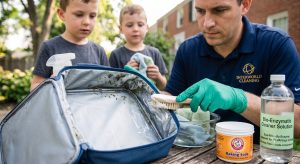
Cleaning contaminated school gear requires a structured approach to prevent indoor air cross-contamination. Follow this process to de-mold backpacks safely right in your backyard or well-ventilated space.
-
1. Outdoor Extraction and Prep
Take the affected gear outside into open air to remove mold from fabric without bleach.
Doing this prevents airborne spores from spreading inside your home.
Next, unzip all pockets and brush away loose surface mold using a soft nylon brush.
Shake out lingering dry debris or paper scraps over an outdoor trash bag. -
2. The Acetic Acid Soak
Mix equal parts distilled white vinegar and cool water in a spray bottle.
Liberally spray the interior and exterior fabric until it is completely damp.
Submerge heavily infested bags in a bucket with cool water and two cups of vinegar.
Allow the acetic acid solution to sit on fabric for 20 minutes to penetrate fungal walls. -
3. Gentle Scrubbing with Enzyme Cleaners
Apply a small amount of plant-based enzymatic detergent directly to stain sites.
Work the solution into the synthetic weave using a soft brush or microfiber cloth.
Avoid harsh metal brushes because they can fray nylon stitching or damage zip tracks.
Rinse thoroughly with cool tap water until all suds dissolve. -
4. Eco-Friendly Lunchbox Sanitization
Avoid submerging insulated lunch bag interiors entirely in water.
Mix one tablespoon of baking soda with dish soap and warm water to form a paste.
Wipe down PEVA or vinyl linings with this mild paste to lift grease and organic film.
Complete eco-friendly lunchbox sanitization by wiping the interior with vinegar, followed by a clean water rinse. -
5. UV Solar Drying
Hang the backpack and lunchbox upside down in full, direct sunlight.
Natural ultraviolet solar radiation acts as a powerful sanitizer to destroy remaining spores.
Ensure all zippers and hidden crevices are completely dry before bringing items indoors.
Maintaining a Healthy Indoor Environment in Baltimore Homes
Unzipping a moldy lunchbox in your mudroom exposes indoor air to millions of microscopic spores. In humid coastal regions like Baltimore, MD, airborne mold spores spread quickly onto carpets and upholstery. Therefore, maintaining gear cleanliness is just one piece of keeping your home environment allergen-free.
When cleaning demands go beyond routine chores, professional intervention makes a major difference. Comprehensive residential deep cleaning targets hidden bio-pollutants, trapped allergens, and carpet mold that daily tidying misses. As a result, removing contamination at the source protects your family’s indoor air quality year-round.
Elevate Your Home’s Health with Interworld Cleaning
Maintaining a healthy living space should not feel like a constant battle against unseen allergens. At Interworld Cleaning, we bring top-tier expertise and eco-friendly standards directly to your home. We are a premier regional provider of commercial cleaning and janitorial services in Baltimore, MD. In addition, our residential deep cleaning specialists understand the exact science of deep sanitization. Our team uses advanced green methods and non-toxic products to eliminate hidden contaminants.
Whether you need seasonal sanitization or carpet cleaning, we deliver results you can breathe easy about. Discover how our eco-conscious services can transform your indoor environment today. Visit Interworld Cleaning to learn more about our customizable solutions. You can also reach out to request your free quote!